

Mark Wallace: Inside Glamorgan’s revival
“It’s easy to think that once you go up, you just automatically bring in lots of new faces. But you have to show trust to the players who had such a good season to get you there."

Mark Wallace was a young wicketkeeper-batter when Glamorgan last graced the top-flight in 2005. Two decades on, now the county’s director of cricket, he reflects on a remarkable promotion campaign, the impact of Richard Dawson, and a renewed commitment to developing Welsh talent – with a little help from The Hundred.
After a disappointing sixth-place finish in Division Two of the County Championship, Glamorgan ended 2024 on a high. A surprise One-Day Cup final victory over Somerset lifted the gloom of a challenging campaign and handed coach Grant Bradburn silverware in his first season – providing a platform to build on ahead of 2025.
Yet, by the turn of the year, that positivity had given way to turmoil. Bradburn was sacked on 30 December 2024 following a charge of misconduct relating to complaints of inappropriate and discriminatory behaviour. Glamorgan’s decisive, zero-tolerance approach was commendable – but left Wallace with an unforeseen New Year’s headache.
“Because of the timing, it was really important we moved quickly,” he says. “That’s why we needed an interim head coach as soon as possible. I knew Richard well from our England U19 days and was aware of his availability. I wasn’t sure if he would take us up on our offer – inevitably, a coach of his ability had plenty of options on the table.”
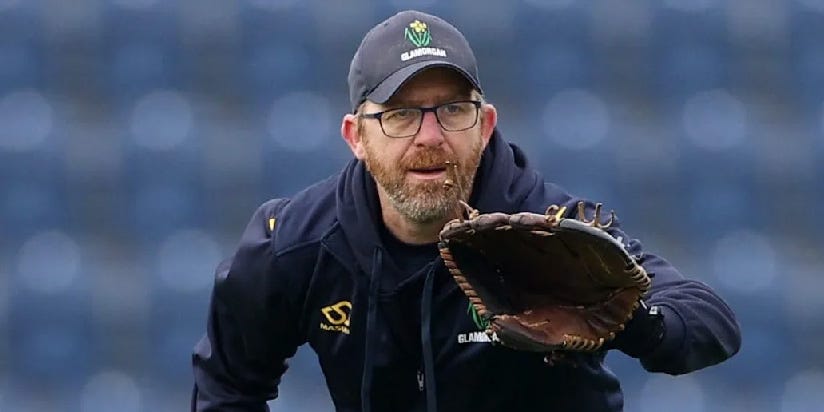
In January 2025, Dawson did accept the role, but due to commitments with England Lions and the Women’s IPL, he was unable to meet up with the squad until March. Wallace, however, refuses to use that lack of contact time as an excuse for Glamorgan’s sluggish start to last season.
“We just didn’t play well,” Wallace admits. “It wasn’t anything specific – we didn’t get out of the blocks and, as a result, were all over the place, to be honest. A month in, Richard probably wondered if he’d made the right decision.”
After three rounds of fixtures Glamorgan sat rock-bottom with just 15 points. Which made what followed – a ten-match unbeaten run that secured promotion with a game to spare – even more extraordinary.
Heading into last season, Wallace’s top priority had been ensuring young players were given genuine opportunities. “Our big mistake when we won the 50-over competition in 2021 was that we didn’t use it as a springboard to involve players in other competitions. This time, we were determined to leverage that success.”
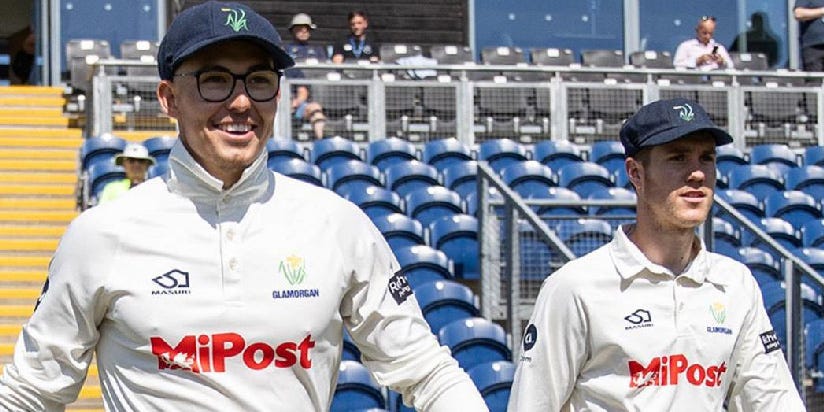
Fittingly, at the heart of last term’s turnaround were two 21-year-olds – all-rounder Ben Kellaway and opener Asa Tribe – and in Dawson, they found the perfect mentor.
“It might sound odd, but first and foremost Richard is a coach – someone who improves players,” Wallace explains. “Coaches as managers are more fashionable these days. Don’t get me wrong, he’s a good manager, but he’s an exceptional coach.”
Kellaway’s breakthrough season underlined that point. Against Gloucestershire in July 2025, he scored 139 and took 6-111 – becoming the youngest player in Glamorgan history to record a century and five-wicket haul in the same match.
“I think it would be arrogant to say Ben didn’t surprise us,” Wallace says. “Did I expect him to do well? Yes. But I didn’t see him becoming player of the year.”
Tribe’s impact at the top of the order was just as important. Together, the pair brought an energy and fearlessness that quickly spread through the squad.
“That’s the modern game,” Wallace says. “The ‘Bazball’ influence is there, but it’s also generational. These players have grown up in a T20 era. They are instinctively positive and naturally look to do things a little outside the box.”
Kellaway embodies that shift. An ambidextrous spinner, he possesses the ability to switch between right-arm off-spin and left-arm orthodox – sometimes in the same over.
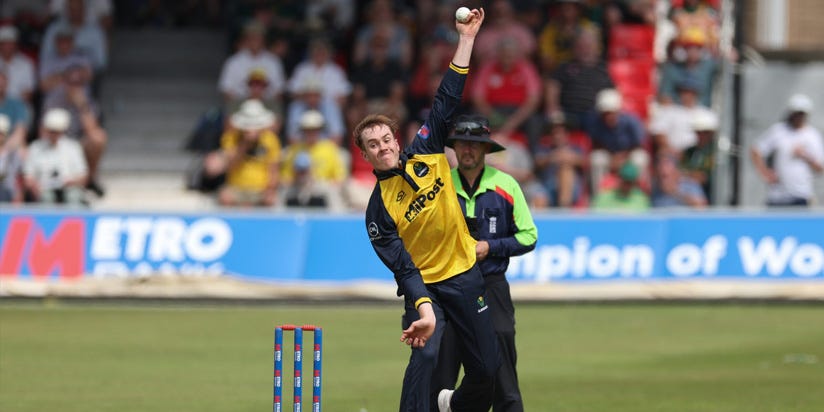
“That’s really a triumph of somebody not stopping him,” Wallace explains. “He’s obviously more comfortable with his right arm, but if you give him the freedom to experiment, suddenly you’ve got a very handy skillset.”
That inventiveness has helped secure Kellaway a contract with Welsh Fire in The Hundred – a competition Wallace believes can play a transformative role for both Glamorgan and cricket in Wales more broadly.
“Welsh Fire has got a real USP,” he says. “Wales hasn’t got a national cricket team. You grow up supporting Wales in rugby and football, but in cricket there’s been no red shirt, no anthem. Welsh Fire has the potential to fill that gap, capture a new, younger audience and create a national identity on the cricket field.”
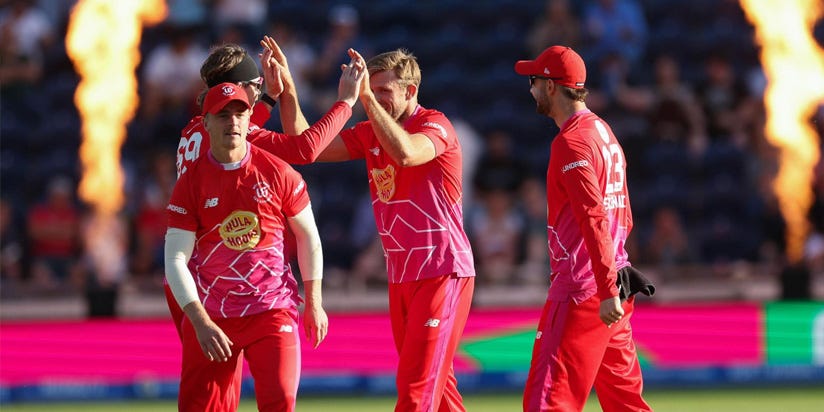
“Cricket is one of those games that hooks you for life,” he continues. “If Welsh Fire can draw people in, ultimately that’s positive for Glamorgan. That money will not only bring the best international players, male and female, into Wales but also improve facilities and grow the game across the whole country.”
Glamorgan’s 2025-28 strategy, Making Wales Proud, sets out an ambitious goal to be become a top-eight county on and off the field, across all formats and key metrics. With promotion secured ahead of schedule, does Wallace believe the current squad has the quality to consolidate in the top division in line with that vision?
“We’re not naive about what lies ahead this season,” he says. “We’ve lost Sam Northeast [who returned to Kent] and James Harris [retired], two big blows and difficult gaps to fill but it’s not always straightforward to bring players in; we spoke to Marnus [Labuschagne] positively, but unfortunately he’s gone to the PSL.”
“It’s easy to think that once you go up, you just automatically bring in lots of new faces. But you have to show trust to the players who had such a good season to get you there – and invest in them.”
With both Kellaway and Dawson signing three-year contract extensions at the end of last season, the club has clearly signalled its intent to continue building around its young core.
“That philosophy is not going to change,” confirms Wallace. “First and foremost, we want to develop and improve our own talent. This year will be more challenging, of course, but they’re great problems to have – and in Richard Dawson, I believe we’ve got the best man to solve them.”

This article first appeared in The Cricket Paper on Sunday 19 April, 2026